
Tesla’s Bitcoin Gamble

Bitcoin

The cryptocurrency and stock worlds collided yesterday with the news that Tesla has bought $1.5bn worth of Bitcoin and will start accepting the cryptocurrency as payments for its vehicles.

Here is the key paragraph from the 10-K statement:

In January 2021, we updated our investment policy to provide us with more flexibility to further diversify and maximize returns on our cash that is not required to maintain adequate operating liquidity. As part of the policy, which was duly approved by the Audit Committee of our Board of Directors, we may invest a portion of such cash in certain alternative reserve assets including digital assets, gold bullion, gold exchange-traded funds and other assets as specified in the future. Thereafter, we invested an aggregate $1.50 billion in bitcoin under this policy and may acquire and hold digital assets from time to time or long-term. Moreover, we expect to begin accepting bitcoin as a form of payment for our products in the near future, subject to applicable laws and initially on a limited basis, which we may or may not liquidate upon receipt.

https://www.sec.gov/Archives/edgar/data/1318605/000156459021004599/tsla-10k_20201231.htm

In the corporate finance world this is a very unusual move by Tesla.

Companies usually park any spare cash in low yielding but very safe investments such as government bonds or just keep it on hand as cash in the bank. Tesla, however, with Elon Musk at the helm, is anything but a “usual” company. As I wrote about earlier on this blog, even though Tesla is the most valuable car company in the world its revenues are nowhere near reflecting its huge valuation.

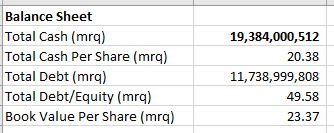
Tesla, though, can certainly afford this investment; its currently sitting on $19bn+ in cash:
But why has Tesla invested in Bitcoin?

Tesla didn’t give a specific reason, other than it provides “more flexibility to further diversify and maximize returns on our cash”. That is all well and good while Bitcoin is increasing in value (currently at $45,000 and up over 50% this year) but how will investors react if Bitcoin heads back down to $10,000 or lower, a level that it was trading at only 5 months ago?

Bitcoin is notoriously volatile; it can move +/-10% in a matter of minutes for no apparent reason. Now we have one of the largest S&P500 companies holding a sizeable Bitcoin position on its balance sheet. I do wonder what Tesla CFO Zachary Kirkhorn makes of all this? A recent Bloomberg report described him as “introducing a more conservative approach to forecasting and provided greater discipline in cost-cutting that has helped Tesla act more like the S&P 500 company it has become.” A $1.5bn Bitcoin investment is quite the opposite of acting like a S&P company!

And I do hope that the Tesla Finance Department has safely stored the details of its $1.5b investment:

Of the existing 18.5 million Bitcoin, around 20 percent — currently worth around $140 billion — appear to be in lost or otherwise stranded wallets, according to the cryptocurrency data firm Chainalysis.

https://www.nytimes.com/2021/01/12/technology/bitcoin-passwords-wallets-fortunes.html

Despite all this investors reacted positively to the news, the stock was up 1.3% whilst Bitcoin surged over 15%. So already the investment is paying off, although no information was provided as to when and at what price the Bitcoin transactions were executed at:
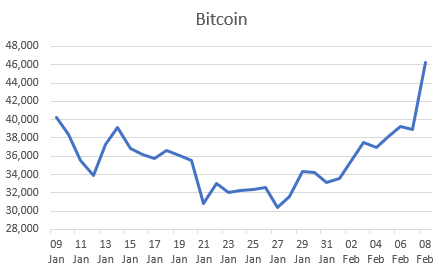
Bitcoin (BTC) price chart

How does this news square with Teslas environmental mission statement?

Well the short answer is that it doesn’t and in fact goes completely against it. Bitcoin consumes annually the electricity output of a small country. Surely if Tesla were serious about tackling environmental issues they would not be investing in Bitcoin? As the price of Bitcoin increases it becomes more economically viable to dedicate more computing resource to Bitcoin mining activities. It is likely that this news from Tesla together with the sharp spike in the Bitcoin price has enabled another warehouse full of machines to start working 24/7 to mine more bitcoin…


All data and the chart shown is provided by Excel Price Feed Add-in market data formulas (Yahoo Finance data).

GameStop (Wall St vs Main Street)

GameStop is a US video game and consumer electronics retailer which operates 5000+ stores across the world. Over the past 5 years the company has steady declined as digital downloads of games overtook the purchasing of physical video games as well as the general move to more internet retailing.

As a result, the company suffered declining revenues and profits, exacerbated more recently by the closure of stores due to the Covid-19 pandemic.

As the fortunes of the company declined, some hedge funds took notice and spotted what was to them easy money: bet on further declines in the company and therefore the stock price. Throughout late 2020 they began building short positions in GameStop stock (GME).

Enter Player 1: The Hedge Funds

How did hedge funds bet on the decline of GME? The hedge funds borrowed stock (from a bank or broker) then immediately sold this stock. At some point in the future they will be required to return the stock to the lender at which point they simply buy it back, at the now hopefully lower price, and pocket the profit.

For example:

  • They borrow the stock at $50.
  • They then sell it immediately for $50.
  • Sometime later, when they are due to return the stock, they buy it in the market for $20 and make $30 profit.

This is called “shorting” and the hedge funds were so sure that GameStop was a lost cause that it quickly became the most shorted stock in the market, in fact so much so that more stock was shorted than the entire GameStop share capital.

Enter Player 2: The Redditors

The other player in this game are The Redditors, an internet community that hangs out on Reddit, an online news and discussion forum. One corner of this site, the Wall Street Bets (WSB) forum, has become a noisy outpost for individual investors disgruntled with the way the closed world of Wall Street makes its vast profits at the expense of people like them. It is filled with members posting trading memes and screenshots of their personal trading accounts, often showing large profits or losses – both are seen as a rite of passage.

Towards the end of August 2020 WSB started to take a keen interest in GME. There was talk of a turnaround in the company and this was exacerbated with the news of ex Chewy Inc (an online pet food retailer) CEO Ryan Cohen buying up about 13% of GME. This news, coupled with the WSB dislike for Wall Street (who were now becoming more vocal in expressing how GameStop was a dying business in a dying business sector) resulted in GME becoming a “cult” stock within WSB.

As Wall Street built up huge short positions, individual investors, using mobile apps such as Robinhood, started buying GME stock. In addition, other WSB members, after seeing the huge option profits made during the March 2020 crash, started buying GME call options. Buying options enabled even those with little cash to spare to join the game and also make much larger gains than simply owning the stock.

The game had started: Wall Street vs Main Street.

Let Play Begin: The Short Squeeze and Gamma Trap

During January, the frenzy on WSB increased: members started frantically buying GME stock and GME call options whilst posting more memes and encouragement.

The market makers selling the call options needed to hedge their exposure so bought some GME stock, this is called “delta hedging”. As the stock price increased, the position needed to be re-hedged by buying yet more stock. This is called the “Gamma Trap”.

The hedge funds, with their large short positions, have to pay a fee as well as provide collateral to the lender, in order to borrow stock. As the stock price increased the fees increased and their collateral requirements increased. Some lenders may even ask for their stock back, in which case they would need to buy it from the market, thereby pushing the price up further. This is called the “Short Squeeze”.

As you may have noticed there are multiple feedback loops: As the stock price went up this forced the hedge funds and options market makers to buy more stock, which caused the price to go up even more, which caused them to buy more stock and so on.

The WSB crowd, at the same time, bought more stock and call options. They encouraged each other to hold and not sell up, no matter what happened to the price. Reports of others making huge profits, in the form of screenshots of their stock accounts showing large profits, flooded the forum. This lead to more of them wanting a piece of the action and more buying of stock and calls.

The result of this can be seen in the chart above: the stock price (and volume) erupted during January, rocketing from $17 at the start of the year to over $350 just 3 weeks later.

Game Over?

So, what happens now? As I write, GME was up 134% yesterday and is already up 6.5% in the pre-market this morning:

WSB is claiming victory over the hedge funds and Wall Street.

Melvin Capital Management is the first victim; a $12b hedge fund that is down 30% this year and was rescued this week with a $2.75b capital injection from other Wall Street players.

The SEC said it was “aware of and actively monitoring the ongoing market volatility in the options and equities markets” and the new Biden administration is “monitoring the situation”.

Will this lead to fundamental market reforms or are we entering a new age of financial power shifting from Wall Street to Main Street?

(PS: whilst writing this article GME has already rose another 20% in the pre-market…).


All data and the chart shown is provided by Excel Price Feed Add-in market data formulas (Yahoo Finance data).