Understanding Company Retained Earnings

We recently received a feature request from one of our users to add “Retained Earnings” to our software.

What are Retained Earnings?

Retained earnings represent the cumulative net income a company has reinvested into the business instead of distributing to shareholders as dividends. In other words, it’s the company’s “savings account” of profits.

Retained Earnings = Beginning Retained Earnings + Net Income − Dividends Paid

This figure accumulates over time and reflects how much profit a company has decided to keep rather than return to shareholders. High retained earnings suggest a firm has consistently made profits and reinvested them.

Let’s compare two companies: Apple and Goldman Sachs

Retained Earnings: Apple vs. Goldman Sachs

As of their latest filings:

  • Apple Inc. had retained earnings of approximately $3 billion.
  • Goldman Sachs reported retained earnings exceeding $140 billion.

This comparison may seem surprising at first—after all, Apple is one of the most profitable companies in the world. So why does a financial firm like Goldman Sachs have retained earnings that dwarf Apple’s?

1. Dividend and Buyback Philosophy

Apple has paid significant dividends and engaged in massive share buybacks. Since 2012, Apple has returned hundreds of billions of dollars to shareholders, reducing its retained earnings in the process. This was a strategic choice to reward investors and reduce excess cash.

Goldman Sachs, on the other hand, has historically paid more conservative dividends and buybacks relative to its earnings. The firm tends to retain a large portion of its profits to meet regulatory capital requirements and to support future investment opportunities, such as trading capital or acquisitions.

2. Business Model and Regulatory Requirements

Goldman Sachs operates in a capital-intensive and highly regulated industry. As a major investment bank, it needs to maintain strong capital reserves to comply with Basel III regulations and withstand market shocks. Retaining earnings is one of the primary ways to build that buffer.

Apple, while capital-intensive in R&D and hardware production, doesn’t face the same regulatory capital requirements. Moreover, Apple’s enormous cash reserves (much of which were held overseas until recent tax reforms) meant it didn’t need to rely on retained earnings in the same way.

3. Use of Retained Earnings

Goldman uses retained earnings to:

  • Maintain risk buffers
  • Fund trading desks and investment banking operations
  • Meet regulatory ratios (like Tier 1 capital requirements)

Apple uses retained earnings to:

  • Invest in new products, supply chains, and technologies
  • Fund marketing and international expansion
  • Supplement shareholder returns

In Apple’s case, excess cash and borrowings have been used as alternatives to retained earnings for strategic initiatives, including acquisitions and R&D.

Retained Earnings and Excel Price Feed

So, how do we easily retrieve retained earnings in Excel? We can use the new formula:

=EPF.Yahoo.AnnualRetainedEarnings("GS",2024)

Which returns the Goldman Sachs retained earnings for 2024.

To find out more about Excel Price Feed head over to the website and try it free for 10 days: https://www.excelpricefeed.com/

Are we in an AI fueled stock market bubble?

AI (Artifical Intelligence) chip on a circuit board

AI is everywhere now; not a day goes by without at least one company releasing an AI related news announcement, the latest being Volkswagen who are integrating ChatGPT into their next generation of cars.

These AI announcements are usually accompanied by a spike in the company’s stock price and this, together with the recent rise in the tech and broader market, has prompted some market commentators to declare that we are in an AI fueled stock market bubble.

Are we in a bubble?

Unfortunately, we will only know if and when the bubble bursts; by its very definition we cannot know if we are in a bubble but let’s crunch some numbers to investigate further.

We’ll use Excel Price Feed to get some financial data into Excel, and we’ll start by looking at the “Magnificent Seven”.

What are the Magnificent Seven? Well, these are the largest, most significant players in the global tech industry, and are leading the charge in bringing AI to the masses:

  • Apple
  • Microsoft
  • Alphabet
  • Amazon
  • Nvidia
  • Meta
  • Tesla

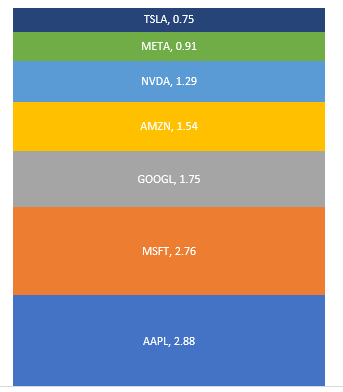
We’ll start with market capitalization, and use the Excel Price Feed formula EPF.Yahoo.MarketCap together with a nice stacked chart to see how they stack up (excuse the pun), units are $trillion:

Magnificent Seven Market Capitalization as of January 2024

The total market capitalization of these 7 companies is almost $12 trillion, but how does this compare to the market in general, say the S&P500?

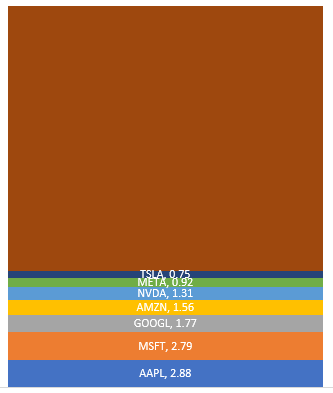
Here we have added the rest of the S&P500 ($27 trillion) and can see that the Magnificent Seven account for more than one quarter of the entire market:

Magnificent Seven stocks market capitalization versus the S&P500

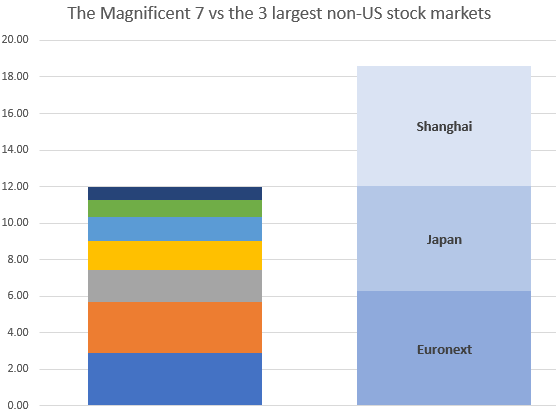
What is even more astounding is how these 7 stack up against entire stock exchanges.

Here we are comparing them with the 3 largest non-US exchanges: Shanghai, Euronext and Japan:

Magnificent Seven market capitalization versus Shanghai, Japan and Euronext stock markets

Now let’s see how they have grown over the last 12 months.

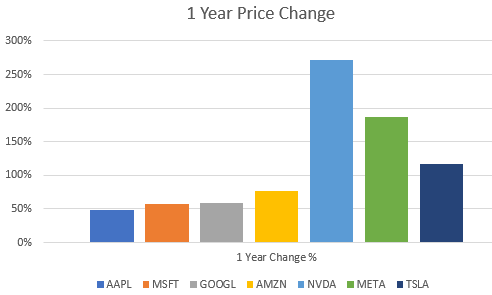
We’ll use the EPF.Yahoo.Historic.Close formula to retrieve the stock price at the start of 2023 and compare it to the current stock price using EPF.Yahoo.Price

Magnificent 7 stocks one year price change chart for 2023

They’ve all increased by at least 50%, with Nvidia, perhaps the most AI centric stock being the star performer.

So, are we in a bubble?

Why not download Excel Price Feed today and crunch some numbers yourself. You can also download the spreadsheet created for this post from our website to get started.

Market Performance 2022 YTD using Excel

Just a quick blog post today, looking at market performance for a bunch of stocks so far this year (otherwise known as year to date or YTD).

As a reference point, today (24 March 2022) the S&P500 is at -6.2% and the Nasdaq is at -11% for YTD.

I am using the Excel Price Feed Add-in to download latest price data and start of year prices for a small set of diverse US stocks. I use the live price formula (EPF.Yahoo.Price) in column C together with the historical price formula (EPF.Yahoo.Historic.Close) in column D to retrieve the stock price on the first trading day of the year which was 3rd January.

This produces the following data table (you can see the formula for cell D2 in the formula bar):

2022 YTD Stock Performance in Excel using the Excel Price Feed Add-in

Now that we have the current stock price and at the start of the year we can calculate the % change using a simple Excel formula which works out the difference (C2-D2) as a proportion of D2:

Calculate stock price YTD change in Excel

Now we can apply this formula to the rest of the table and create a simple bar chart to visualize the performance:

YTD stock performance bar chart in Excel

As we can see the tech sector is under-performing, particularly Facebook and Netflix whilst the oil giants Exxon and Chevron are out-performing everything else.

I hope this gives a good introduction to stock analysis using Excel, to find out more about Excel Price Feed head over to the website and try it free for 10 days: https://www.excelpricefeed.com/

Tesla: The most valuable car company in the world?

Tesla Model S car

Tesla is in the headlines, yet again, this time as it’s share price hits $500. The latest jump in price was triggered by the news that Tesla will join the S&P500 in December; it is now by far the most “valuable” car company in the world:

In 2020, Tesla has become the world’s most valuable car manufacturer and blown its sales forecasts out of the water.

Tesla soars as much as 13% after the automaker nabs a spot on the exclusive S&P 500 index | Markets Insider (businessinsider.com)

What exactly does “most valuable company” mean?

Market capitalzation is the most common measure, in the financial press, to gauge how valuable a company is. Market capitalization is simply:

Number of shares outstanding (x) the share price

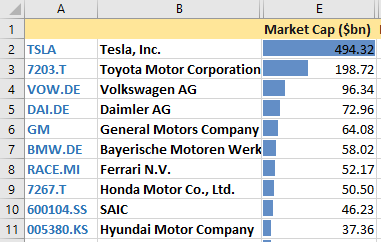
That is, how much it would cost to buy all the outstanding shares of a company. On this measure, Tesla is certainly the most valuable:

Largest, by market capitalzation, car companies in the world.

Another measure is Enterprise Value:

Market Capitalization (+) Total Debt (-) Cash & Cash Equivalents

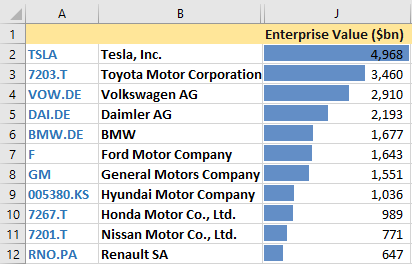
Enterprise Value is the cost of how much it would actually cost you to buy the company, as you would not only need to buy all outstanding shares but also take on all debts of the company. You could offset some (or all) of the debt by the amount of cash & cash equivalents (i.e. liquid assets) that the company owns. Enterprise Value is often used as the theoretical takeover price of a company.

In this case, Tesla is still the most valuable car company but the other car companies are much closer in value:

Largest, by enterprise value, car companies in the world.

I think we can safely say that Tesla is currently the most valuable car company in the world but maybe not by such a large margin as the financial press reports.

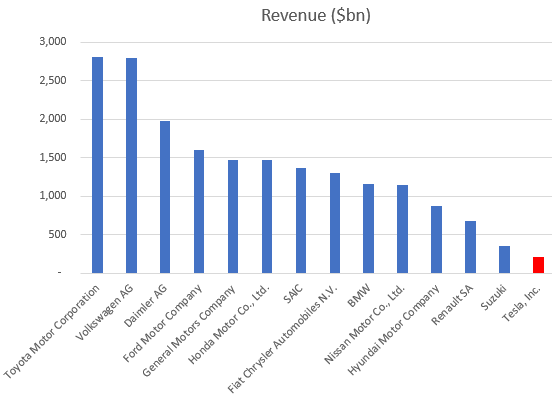
What about revenues, surely a company must have large revenues to justify a large valuation?

Global car companies annual revenues.

Tesla earns a fraction of the other car companies; investors are betting on Tesla growing these revenues substantially over the coming years…..

All data in the spreadsheet shown is provided by Excel Price Feed Add-in market data formulas (Yahoo Finance data).

Pre-market stock prices

Stock markets are generally only open during specific times, the “trading day”. For example, the US market is open from 9:30am to 4:00pm (EST).

However, this is not the only period when trading takes place and when prices can change, there is also the pre-market which is “open” before the regular market opens.

This is a time of very little liquidity however trading during this time can enable you to take advantage of any news or events that happen outside normal market hours.

Yahoo Finance provides prices during this period, the pre-market (or before hours) prices.

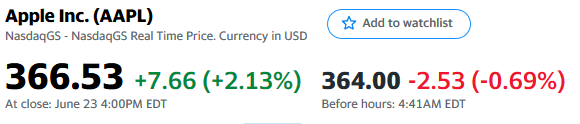
For example, below we can see the current “before hours” price for Apple stock is 364.00 and the price has moved -2.53 from yesterdays close price of 366.53:

Apple stock price: live and pre-market

We have recently added some new Excel formulas to the Add-in to provide pre-market prices in Excel:

  • EPF.Yahoo.PreMarketPrice
  • EPF.Yahoo.PreMarketChange
  • EPF.Yahoo.PreMarketChangePercent
  • EPF.Yahoo.MarketState

This last formula is used to find the current state for the market eg. whether we are in regular or pre-market trading hours: “REGULAR” or “PRE”.

The example spreadsheet below shows the formulas in action, you can see column C uses the PreMarketPrice formula which references the ticker in column A:

Excel Price Feed pre-market stock prices

We hope you find these new formulas useful and as ever keep your feedback coming, preferably on the Support Forum or leave a comment below.